


Renewable biogas and reduced emissions
Viking Line’s emissions target
The maritime sector is undergoing a transition in which fuel choices play a key role in reducing greenhouse gas emissions. Viking Line aims to reduce net greenhouse gas emissions from its maritime operations to zero by 2050, in line with the International Maritime Organization’s (IMO) greenhouse gas strategy.
To achieve this target, fossil fuels need to be gradually replaced by alternatives with lower greenhouse gas emissions, including renewable fuels. Their availability is still limited and they are more expensive than fossil fuels. The transition will therefore take time.
Renewable biogas
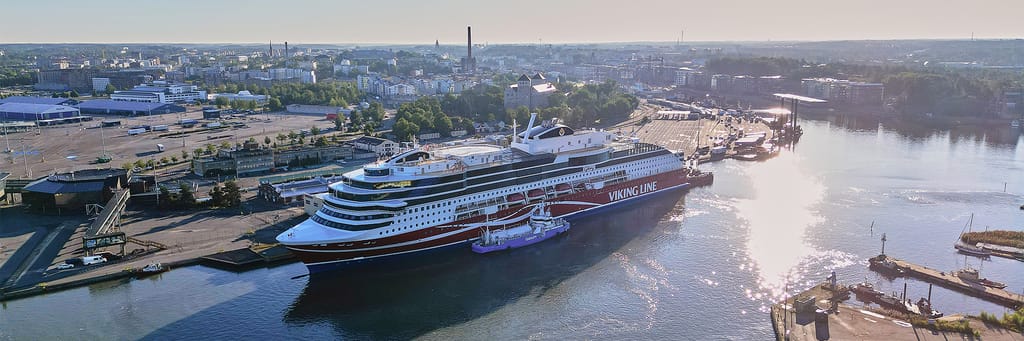
Viking Line’s newest vessels, Viking Glory and Viking Grace, operate on a combination of renewable biogas (LBG) and liquefied natural gas (LNG). Viking Line’s other vessels cannot currently use gas as fuel.
The ISCC-certified biogas purchased by Viking Line is produced from biowaste, food industry residues and agricultural waste. Biogas is not emission-free. Its climate impact is assessed across its entire life cycle, and its overall emissions are generally lower than those of liquefied natural gas. The level of emissions reduction depends on factors such as feedstocks, production methods and supply chains.
Mass balance tracks the amount, not the molecule
Renewable biogas and natural gas consist mainly of methane but come from different sources. Biogas is produced from renewable feedstocks, while natural gas is fossil-based. Both are transported through the same gas infrastructure and can mix before reaching the end user. Once mixed, the individual gas molecules can no longer be distinguished based on their origin.
Mass balance is used to track and report the amount and characteristics of renewable biogas. The method keeps the renewable and fossil shares separate in the documentation even when the gases have been physically mixed. This ensures that the amount of certified renewable biogas purchased by Viking Line corresponds to the amount produced and injected into the gas system.
The principle is comparable to purchasing electricity from renewable energy sources: in both cases, the amount purchased is tracked and reported rather than the path taken by an individual unit of energy through the system.
Under maritime regulations, certified biogas purchased by Viking Line and allocated to the company through mass balance is reported as Viking Line’s use of renewable biogas. The emissions reduction resulting from the lower life-cycle emissions of biogas is therefore included in Viking Line’s reporting.
Viking Line’s purchases of renewable biogas
The amount of renewable biogas purchased by Viking Line can vary over time but has increased significantly in recent years. In 2023, Viking Line purchased 10 tonnes, rising to around 600 tonnes in 2024 and almost 7,000 tonnes in 2025.
The increased use of biogas reduced Viking Line’s greenhouse gas emissions by approximately 50,000 tonnes in 2025 compared with the previous year. Read more about the biofuel surcharge.